
Views: 0 Author: Site Editor Publish Time: 2026-10-16 Origin: Site


Industrial boilers create extreme, unforgiving environments where equipment failure simply is not an option. Standard piping materials routinely warp, crack, or corrode when subjected to continuous thermal stress. Meanwhile, high-pressure steam can destroy weak microstructures in a matter of weeks. Solving this engineering challenge requires materials built specifically for thermal endurance.
In modern power generation and heavy industry, the Alloy Steel Seamless Pipe has emerged as the ultimate solution. By eliminating the vulnerable welded seam and utilizing precise chemical compositions, these components deliver the mechanical stability necessary to keep facilities running safely under brutal conditions.
Unmatched Thermal Endurance: Specially engineered alloys maintain structural integrity under extreme pressure and heat, preventing catastrophic deformation.
The Seamless Advantage: The complete lack of a welded seam eliminates critical weak points, drastically lowering the risk of bursting during cyclical heating.
Industry Standards: Specifications like SA-210 dictate the exact chemical and mechanical properties required for reliable, efficient boiler operation.
Manufacturing Matters: Knowing the difference between hot-rolled and cold-drawn production helps engineers select the perfect pipe for specific dimensional needs.
Smart Sourcing: Procurement requires a careful balance of material grades, operating thresholds, and rigorous quality control testing.
When sizing industrial heating systems, engineers must select materials capable of withstanding severe operational stresses over decades of continuous use. Field inspections frequently reveal that standard carbon steel suffers from accelerated degradation when exposed to continuous high-temperature environments. Phenomena like graphitization and creep rupture happen rapidly under these conditions. To combat these metallurgical failures, specialized alloys are deployed. They provide the necessary mechanical stability and thermal endurance required for modern power generation.
The enhanced performance of these pipes comes directly from their precise chemical makeup. By introducing specific elements into the carbon steel matrix, manufacturers fundamentally alter how the metal behaves under stress.
Chromium: Increases high-temperature strength and provides exceptional resistance to oxidation. It forms a stable oxide layer on the surface, protecting the underlying metal from corrosive flue gases.
Molybdenum: Crucial for increasing the high-temperature creep strength of the steel. It ensures the metal does not slowly stretch or thin out under continuous internal pressure.
Vanadium: Refines the grain structure, improving overall toughness and yield strength. This refinement is vital for handling sudden pressure spikes during startup and shutdown cycles.
Moving beyond chemical makeup, the physical structure of the piping is equally critical. Welded pipes contain a longitudinal seam that introduces a heat-affected zone. Under the constant thermal expansion and contraction of a working boiler, this seam acts as a stress concentration point. Over time, it becomes highly susceptible to fatigue cracking. A seamless structure eliminates this vulnerability entirely. Consequently, it offers uniform strength across the entire circumference of the cylinder.
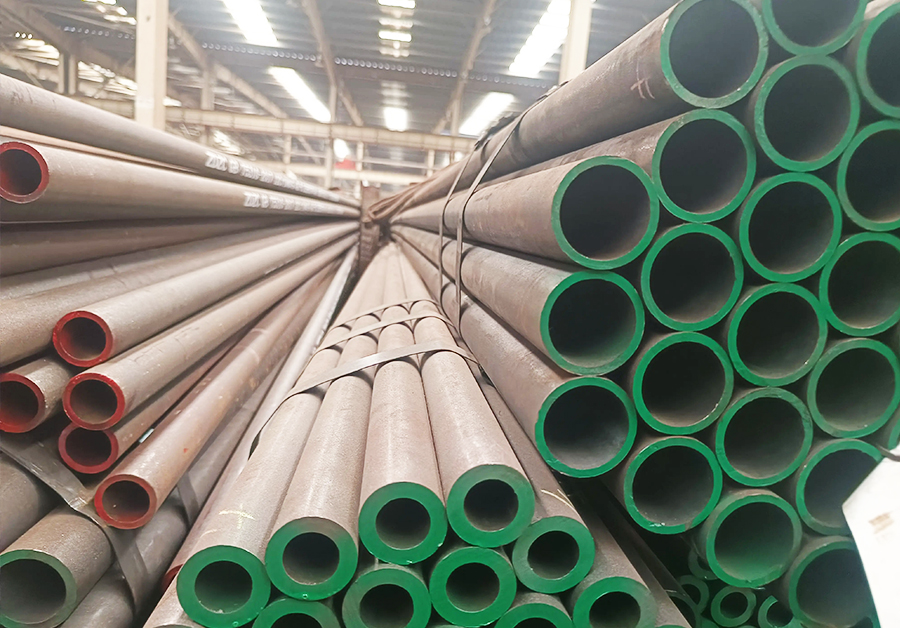
To ensure operational safety and system longevity, materials used in boiler construction must exhibit specific physical and chemical traits. Imagine the internal environment of a utility boiler. The tubes are battered by glowing combustion gases on the outside while containing highly pressurized steam on the inside. Only materials with highly specific characteristics survive here.
Piping systems must carry high-pressure steam while simultaneously enduring external heat. This dual stress requires exceptional tensile strength, meaning the maximum stress the material withstands before tearing apart. They also require robust yield strength, which is the exact point where plastic deformation begins. Advanced alloys maintain these metrics even at glowing temperatures, effectively preventing the Boiler Tube from sagging between structural supports.
Inside the system, superheated steam can cause severe internal oxidation. This forms a brittle magnetite scale that eventually flakes off and blocks flow. Externally, tubes face aggressive corrosive attacks from combustion byproducts like sulfur and ash. The strategic addition of chromium creates a robust chemical barrier. This barrier resists both internal oxidation and external corrosion, thereby extending the equipment lifespan significantly.
Efficient energy transfer remains the primary function of any heating system. These alloys provide excellent thermal conductivity, allowing heat from the combustion chamber to transfer rapidly into the water. Furthermore, they are engineered to have predictable coefficients of thermal expansion. This ensures the entire network expands and contracts uniformly without warping or placing undue stress on headers and tube sheets.
The global energy sector is rapidly shifting toward ultra-supercritical power generation. To maximize thermal efficiency and slash carbon emissions, modern utility boilers are pushing operating temperatures beyond 600 degrees Celsius and pressures over 30 megapascals. This aggressive operational baseline renders traditional carbon steel entirely obsolete for superheater zones. Consequently, the industry is seeing a massive surge in demand for advanced creep-resistant alloys. Facilities are actively upgrading their infrastructure with high-chromium grades to handle these brutal new baselines safely and efficiently.
Selecting the correct material requires strict adherence to international engineering standards. These frameworks guarantee that the components have undergone rigorous testing and meet exact metallurgical criteria.
As a foundational standard in the industry, ASME SA210 governs seamless medium-carbon steel boiler and superheater tubes. It is specifically designed for applications requiring moderate to high thermal endurance and excellent heat transfer capabilities. For example, Grade A-1 requires a minimum tensile strength of 415 megapascals, making it highly reliable for medium-pressure water walls. Facilities heavily favor SA210 due to its reliable performance and cost-effectiveness in standard utility environments. However, engineers must carefully calculate operational limits. Environments pushing past 426 degrees Celsius require transitioning to higher alloy grades.
When operational temperatures exceed the capabilities of medium-carbon specifications, high-alloy grades step in. These are classified primarily by their percentages of chromium and molybdenum. The following table provides a practical selection guide based on real-world engineering parameters.
Material Grade | Key Alloying Elements | Min. Tensile Strength | Safe Max Operating Temp | Primary Engineering Application |
|---|---|---|---|---|
Grade T11 | 1.25% Chrome, 0.5% Moly | 415 MPa | ~540°C | Standard superheaters, reheaters, and heat exchangers. |
Grade T22 | 2.25% Chrome, 1.0% Moly | 415 MPa | ~580°C | High-temperature utility boilers, advanced steam lines. |
Grade T91 | 9.0% Chrome, 1.0% Moly + Vanadium | 585 MPa | ~600°C+ | Ultra-supercritical power plants, extreme heat environments. |
The manufacturing process significantly influences final dimensions, surface finish, and mechanical properties. Understanding these two primary production methods ensures accurate specification for your project.
The hot rolling process involves heating a solid steel billet above its recrystallization temperature and piercing it to create a hollow tube. This hot cylinder is then stretched to achieve the desired diameter. The primary benefit here is cost-effectiveness and rapid production efficiency. It is highly suitable for producing large-diameter, thick-walled components used in heavy-duty main steam lines where extreme dimensional precision is less critical.
In contrast, cold drawing takes a previously hot-rolled tube and pulls it through a precision die at room temperature. While this requires more energy and time, it yields significant advantages. Cold-drawn products exhibit superior dimensional accuracy, tighter tolerances, and a remarkably smooth surface finish. Furthermore, the cold working process induces strain hardening, thereby increasing yield strength. These traits make them ideal for intricate internal bundles and precision heat exchangers.
Ensuring a component can survive unforgiving environments requires strict adherence to advanced manufacturing protocols and exhaustive quality control testing. Visual inspections simply do not suffice in heavy industry.
Creation begins with the careful selection of raw billets to ensure exact chemical composition. The billet is heated to extreme temperatures, pierced, and elongated using a mandrel mill. Finally, it passes through a sizing mill to achieve its final outer diameter before undergoing controlled cooling and heat treatment procedures. Processes like normalizing or tempering are essential to optimize the internal grain structure.
Manufacturers must employ comprehensive non-destructive testing. Ultrasonic scanning and eddy current inspections evaluate the entire length for hidden internal flaws or micro-cracks without damaging the material. Following this, hydrostatic testing pressurizes the sealed tube with water well beyond its intended operating load. This guarantees the pipe will not leak or burst under real-world steam pressure.
While these materials represent the gold standard for demanding applications, an objective analysis of their pros and cons is necessary for informed procurement.
The foremost advantage is maximum operational safety. Removing the weld seam eliminates the highest-risk failure point in a pressurized system. This leads to unparalleled high-temperature performance, greater system longevity, and significantly lower long-term maintenance costs. Their uniform structure also ensures predictable thermal expansion, reducing mechanical fatigue.
The primary limitation is the initial capital investment. Complex manufacturing processes make seamless variants more expensive than standard welded alternatives. Additionally, lead times for highly customized or specialized grades can be longer. This requires proactive project scheduling and robust supply chain management from procurement teams.
Selecting the correct piping material is a complex engineering decision that directly impacts the safety and longevity of the entire facility. Procurement managers and facility operators cannot afford to rely on guesswork. The decision matrix requires a systematic evaluation of thermal parameters, mechanical stress limits, and regulatory compliance.
The most critical step is accurately calculating the maximum continuous operating temperature. If a pipe operates above its metallurgical limit, it experiences rapid loss of tensile strength. For systems operating around 400 to 426 degrees Celsius, medium-carbon specifications like SA-210 are excellent. However, if the system involves superheaters operating above 500 degrees Celsius, buyers must transition to high-alloy grades containing higher concentrations of chromium and molybdenum to prevent thermal degradation.
To justify the investment in specialized grades, buyers must understand empirical failure modes. Creep rupture, which is the slow and permanent deformation of material under constant mechanical stress at High Temperature, is a primary concern. High-alloy materials are explicitly engineered to resist this microstructural movement. Additionally, recognizing the risks of fireside corrosion from ash deposits helps in selecting a chemical composition robust enough to withstand aggressive external attacks.
Never procure industrial piping without demanding comprehensive documentation. Buyers must verify that materials comply strictly with relevant international standards. Always request a mill test certificate from the manufacturer. A Type 3.1 or 3.2 certificate provides empirical proof of the chemical composition, heat treatment history, and the results of all mechanical tests performed during quality control.
The complexity of high-temperature metallurgy means procurement should not be based on price alone. Partner with experienced manufacturers who possess a proven track record in heavy industry. A reliable supplier offers custom sizing, transparent quality assurance processes, and expert guidance to ensure the chosen solution perfectly aligns with your specific engineering parameters.
Boiler systems demand highly durable materials engineered for the extreme. By leveraging specific chemical compositions and a structurally uniform design, these pipes deliver outstanding Heat Resistance and mechanical stability. Choosing the proper specifications prevents expensive downtime and mitigates the risk of dangerous failures. If you are upgrading an existing facility or designing a new ultra-supercritical boiler, sourcing the right materials is non-negotiable. Explore the premium selection of compliant, rigorously tested piping solutions at THX Special Steel to find the exact metallurgical match for your next high-pressure project.
The maximum operating temperature is entirely dependent on the specific chemical composition of the grade. While standard carbon steel typically reaches its structural limit around 426 degrees Celsius, low-alloy grades like T11 and T22 are engineered for environments up to 540 and 580 degrees Celsius, respectively. For ultra-supercritical systems, advanced high-alloy pipes can comfortably handle continuous exposure exceeding 600 degrees Celsius without suffering from severe creep deformation.
This specific standard is strictly specified for seamless medium-carbon steel boiler and superheater tubes. It is highly favored in the power generation industry because it offers an optimal balance of tensile strength, ductility, and thermal conductivity. This ensures safe and efficient heat transfer in medium-pressure environments, while its controlled carbon content provides excellent workability for cold bending and flanging.
From an engineering and safety standpoint, welded pipes are generally not recommended for high-pressure, high-heat boiler applications. The longitudinal weld seam acts as a structural stress riser and introduces a heat-affected zone. Under extreme, cyclical thermal expansion, this seam becomes highly susceptible to thermal fatigue and eventual rupture, making a seamless structure the much safer choice.
Cold drawing is a secondary manufacturing process where a hot-rolled tube is forcefully pulled through a precision die at room temperature. This significantly improves the tube by inducing strain hardening, which elevates yield strength. It also provides exceptional dimensional precision for tight tolerances and produces a remarkably smooth surface finish, which minimizes friction and reduces the accumulation of internal scale.
Carbon steel lacks the added chromium and molybdenum found in alloy steel, which limits its safe operating temperature to around 426 degrees Celsius. Alloy steel includes these specific elements to prevent creep deformation and severe oxidation, allowing the pipes to operate safely at much higher temperatures and pressures.
When correctly specified and maintained within their thermal limits, these tubes often operate safely for 20 to 30 years. However, frequent temperature spikes, poor water chemistry, or aggressive ash corrosion can significantly reduce this lifespan, making routine ultrasonic inspections critical for plant safety.


